.png)
Waiting For Magic Hour
Critic:
William Hemingway
|
Posted on:
Sep 15, 2025

Directed by:
Gerard Lough
Written by:
Gerard Lough
Starring:
Aline Almeida, Aidan O'Sullivan, Michael Parle
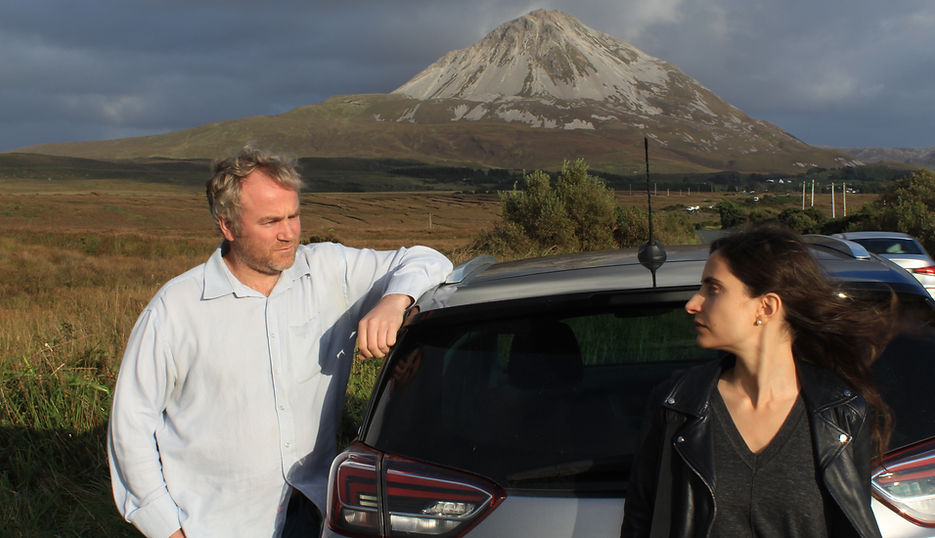
An out-of-town photographer and her driver visit the sights of Donegal to get some snaps of the local landmarks, all the while trying to find some common ground from which to build their relationship.
Natalya (Almeida) has just landed in Donegal for a job. She’s got to get out and about in the local area and find the best beauty hotspots to photograph for a new calendar. Her driver, Sean (O’Sullivan), is also there to act as some sort of guide, and he takes her out to the coast early in the morning before the sun comes up so that she can capture the ‘Magic Hour’; that special time of day, just before sunrise or sunset, when it’s not quite day and not quite night, where the light does some magical things, and which photographers are drawn to like moths to a flame.
Right from the start, Natalya comes across as pretty stand-offish, and she only sees Sean as being there to get her from place to place and nothing else. So, when he starts asking questions about the photography, and just what it is that Natalya wants to capture on this assignment, she brushes him off pretty quickly and makes clear that she’d rather he stay quiet. Sean, however, can’t not use his gift of the gab, and keeps pressing Natalya to open up a little as they spend some time together. Wherever she goes, he follows like a little lost puppy, hanging in the background like a bad smell while she pops off a few rounds of the shutter to snap a hill, or a wave, or an old ruin.
While they get out and about in the countryside, the odd-couple are buffeted by some pretty overbearing music which accompanies them on their travels. The 80’s synth-pop blasts out over the visuals from composer Michael McElroy, never really making the effort to match up with what’s happening on screen, building an emotional resonance all of its own without seeming to take into account the motivations or actions of the characters. There’s a sense of heightened action and intensity which comes from the music, trying to imbue the story with immediacy and excitement, while in actuality two people stand by a roadside or argue about an umbrella on a beach.
There’s not a lot of plot action going on in Waiting For Magic Hour, which might help explain the dominance of the soundtrack in the film. With writer/director Gerard Lough being a veteran filmmaker of short films and music videos, he leans into his expertise to tell us the story in his own way. Most of the driven narrative comes from the music itself, with there being very little on offer from the almost non-existent plot and the minimal dialogue, meaning that most of the film takes on the form of a music video, where we follow the characters around the scenes, from location to location, all to the sounds of a synthesizer and not much else.
The acting, too, lets the film and the storytelling down, as nobody is suited to their role or is able to offer a convincing portrayal of who they’re supposed to be. Almeida, in particular, finds it difficult to get her words out, with her strong accent getting in the way of understanding what she is saying, especially in the latter stages of the film. Her character, too, is let down by the fact that her pictures are pretty poor, marking her out as less than professional as a photographer. O’Sullivan, as Sean, never convinces either, delivering his lines flat, or nearly not at all, with no real feeling behind any of them, while Michael Parle as the jobbing actor George, ironically comes across as the worst actor of the lot.
In the end, Waiting For Magic Hour outs itself as a rom-com, just one with no romance and no comedy involved. The conversations are so stilted and minimal that it’s almost impossible a relationship could develop between the two characters, especially when there’s no chemistry on screen either, and the closest they get to romance is realising that they kinda quite like each other. Thankfully, the film has been cropped at the fourteen-minute mark, so there’s no languishing about in the scenario, but then there’s not much scenario to talk about in the first place. Lough’s cinematography is the highlight of Waiting For Magic Hour, taking in as much of the Donegal countryside as he can get, but even that isn’t enough to make up for the lack of story and characterisation elsewhere.


About the Film Critic
