.png)
Marion’s Lilies
Critic:
Patrick Foley
|
Posted on:
Nov 25, 2025

Directed by:
Marcello Mantero
Written by:
Marcello Mantero
Starring:
Marcello Mantero
A gruesome murder leads to a husband’s descent into darkness in Marion’s Lilies, Marcello Mantero’s short psychological thriller that confronts the realities, consequences and heartbreak of revenge.
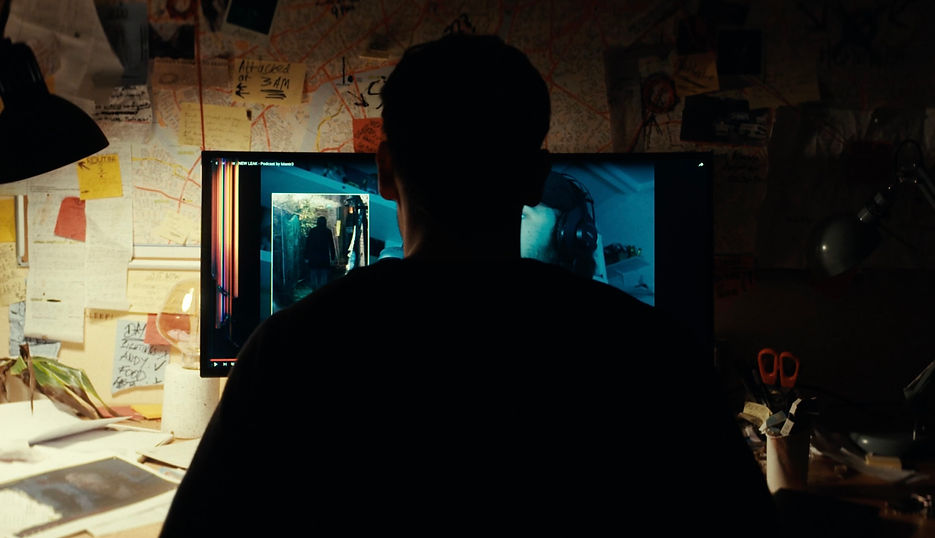
Reeling from the death of his wife at the hands of shadowy serial killer ‘The Owl’, David (Neil Bishop) obsesses over enacting revenge on the man responsible. Enraged by the sluggishness of the police, he embarks on his own investigation using his friendship with a homeless witness of the crime, Andy (John Britton), to try and find his own leads. As time goes by, David considers ever more extreme lengths to take revenge – to the point where his own morality abandons him.
Unless your film stars a muscle-bound 80s action hero and features at least 12 explosions, filmmakers are honour-bound to conclude that revenge is, in fact, a bad thing. But few films imbibe this lesson quite as much as Marion’s Lilies. Taking place in the aftermath of a murder, Neil Bishop’s David is already a husk of a human at the film’s opening. Overwhelming grief quickly turns to anger and bloodlust, and our overall picture of the character is that of a ruthless and committed vigilante. The degree of David’s darkness actually asks a question that may be more interesting than the filmmaker intended at the film’s origin: is this darkness within us? Or is it caused by outside factors? David’s mother and items around his home suggest David has been turned by the event of his wife’s murder. But his resourcefulness and embrace of anger suggest this side of him is one that has always been present. The speed at which he grows tired of the police and the callousness he treats those who offer him kindness are further evidence of this.
The noir influences are clear to see in the shadowy night-stalking sequences that are truly thrilling, as David puts his revenge plan into action. The film looks fantastic, with the streets David walks suitably consuming and hostile. For a film as dark both in terms of content and appearance, it is lit beautifully – avoiding the pitfall that so many contemporaries fall into when important action scenes end up barely visible due to a need to black-out the shot. Mantero avoids this comfortably, understanding that drama outweighs visual authenticity in such moments.
There are a few moments where the film stretches credibility. Much of David’s investigation relies on police reports on TV and Radio – an effective way of demonstrating his amateurish tendencies (that he cannot see in himself) but raising a natural question of why such information would be made public at all. Exposition-heavy dialogue in general rears its head one too many times, with David himself outright stating his motivations and characters around him outlining the story’s message and themes in ways that feel easily improved upon with a stricter edit. And whilst Neil Bishop impresses in general as David, his unhinged explosiveness is ropey in parts, and the performance could have benefited from more restraint.
Revenge has rarely been so prominent in a film’s narrative as it is in Marion’s Lilies. From the filmmaker’s own description of the project, it is possible that some of the intentions of the narrative are not met by the delivery of the production. Some of these (like the darkness David embraces) are actually to the film’s benefit, whilst others (the bluntness of the dialogue) detract from it. Nevertheless, this is a memorable, unrelenting thriller that looks great and isn’t afraid to take chances with its script and characters.


About the Film Critic
