.png)
Just the Usual
Critic:
James Learoyd
|
Posted on:
Dec 3, 2025

Directed by:
Nanna Tange
Written by:
Nanna Tange
Starring:
Søren Sætter-Lassen, Petrine Agger, Casper Kjær Jensen
Just the Usual is a rich and emotional Danish film about an older hairdresser, Ole Benny (played terrifically by Søren Sætter-Lassen), and how exactly he spends his final day before his beloved barbershop closes. He encounters a few other characters through the story who each illuminate a different facet of his professional life – much like the narrative structure of a fable. But at its heart, this is a tale of a deeply lonely man who is about to lose a significant aspect of his identity: his passion. The film’s running time is 27 minutes. It’s a slow, textural, contemplative film; one which won’t entirely sit right with everyone for its slow place. Yet, this is an immensely accomplished piece – masterfully designed, performed and constructed. A wonderful picture.
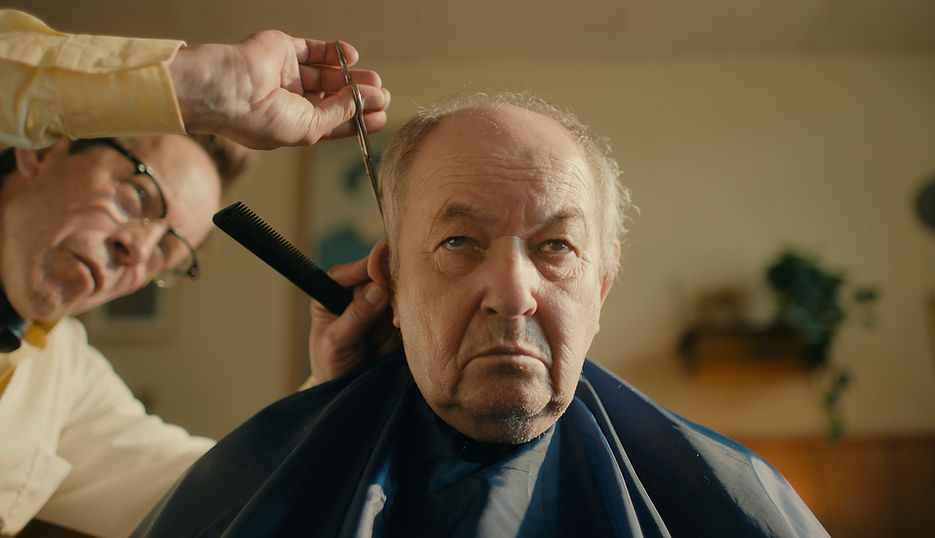
There’s plenty to discuss when it comes to the visuals. The first thing that strikes you is the flawless set-design. The Wes Anderson-feeling colours; the vintage lights; the pleasing combination of materials and eras. That, combined with what Ole Benny looks like as a character – the particularities of his formal wear, his use of hairspray and black-rimmed glasses – really infuse the story with a fully-realised sense of style. Directorially, this is an incredibly confident piece. The camera is seemingly always in the right place, as the lenswork, in turn, complements the arrangement of the location.
One characteristic of the cinematography which I’d like to draw attention to is the effective yet sparing use of the dolly shot. In the opening shot – in addition to one or two shots later on – the camera slowly slides forward through the location, and it’s incredibly satisfying. It’s a form of camera movement whose sensibility seems to match nicely with the lines, operations and smooth surfaces of the establishment; – and heightens a certain sense of meticulous care and focus from the protagonist himself.
Writer-director Nanna Tange has done a truly immaculate job with the mise-en-scene of this movie. There’s not a detail in any frame which doesn’t please the eye or stimulate the senses in some way. I found myself becoming very relaxed due to the pastel balance of the colours, the softness of the light, the crispness of the sound, and of course, the slow flow of the pace. Anyone can tell that, from the form and technicalities alone, this movie is a wonderful and positive work. But I’d argue that it’s the central performance – its tenderness, charisma and emotional depth – that elevates this smooth aesthetic into genuinely moving territory.
The conceit itself if quite random; this isn’t a setup we’ve seen before, and in addition to that fact, it’s being depicted in a uniquely restrained, matter-of-fact manner. Some may find such a setup intriguing, but maybe too mundane to sustain their attention. But it’s the opinion of this critic that the concept and lax runtime provide a refreshingly open space for the filmmakers to form their tone, and – maybe most importantly – for the lead performer to find the beauty and complexity in his character. In summation, this is a near-masterpiece; and potentially a film which, due to its refined, comforting tone and deep sense of identity, a film I may be inclined to revisit.


About the Film Critic
