.png)
In Need Of Seawater
Critic:
William Hemingway
|
Posted on:
Nov 25, 2025

Directed by:
Richard Yeagley
Written by:
Mark Anthony Thomas
Starring:
Mark Anthony Thomas, Ziaire Mann
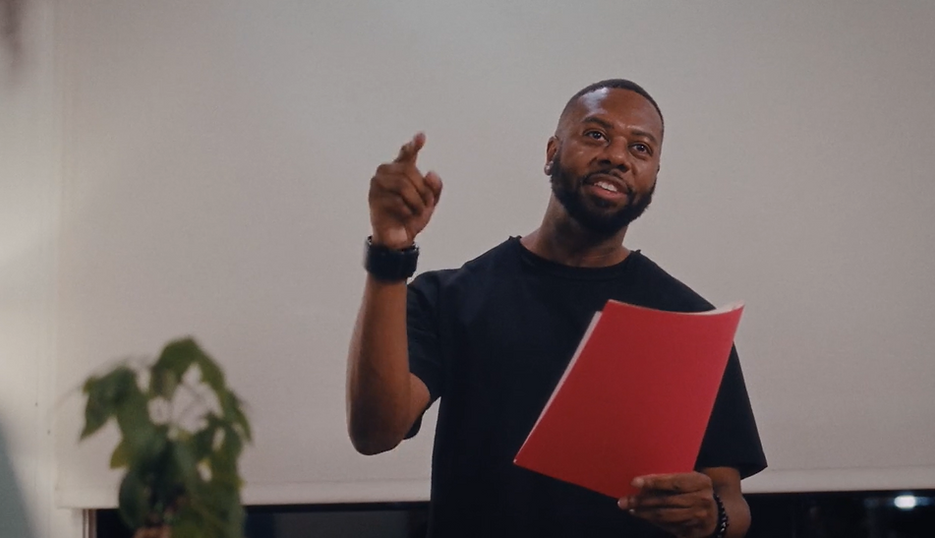
A poet invites a small group of his mates round to read to them a retrospective of his most formative work.
In 2004, Mark Anthony Thomas released his second major work of poetry, The Poetic Repercussion, containing a series of poems he wrote between the ages of twenty-one and twenty-four. The poems described his journey to manhood, and self-discovery, as a gay black man growing up in Atlanta, Georgia, and tried to relate the experiences, feelings, and desires he encountered along the way; those which shaped him into the man he would eventually become. Now, more than twenty-years later, and living in Baltimore, Maryland, Thomas has decided to revisit his earlier work and plans to release a trilogy of films about his poetry. This first film, In Need Of Seawater, intends to look back at ‘the past’, while it is assumed that the next instalments will focus on ‘the present’ and ‘future’ respectively.
In Need Of Seawater, then, takes us back to 2004, when Thomas’ feelings were so strong that he just had to get them out onto the page. The poems are full of growth, and becoming, and clear sight, and quiet understanding, whilst distilling the energy of turmoil and inequality into reasoned words and rhythms. Thomas gathers a few of the faithful, people who know him from his work in publishing, civic leadership, or from his poetry, and gives a private reading for them in an uptown, modern, Baltimore apartment. The film records this event intimately, moving between the guests and the performer, watching the emotions spread across the faces of the gathered, as well as the nodding heads and the knowing glances, as Thomas reads his poetry aloud.
Slotted into the narrative of the readings, between the lines and verses, are some staged scenes, historical footage, and home movies, which represent the themes, events, and emotions that Thomas is trying to convey. These interludes take us away from the enclosed space of the well-lit apartment, and whisk us away to the sea, to the park, to the homes and neighbourhoods of others, and to the past, giving us a visual insight into the words that we hear; those that flowed from Thomas’ pen. We are both at once, listeners and viewers, as we are also invited into this small space to experience the creative expression Thomas gives to his feelings, and we go on the journey with his audience, partaking in the literary emergence of a man who feels he must share with us all of who he is in order to survive.
For twenty-six minutes we sit with Thomas as he moves around the room and reads his poetry from loose-leafed pages. This starkness of intimacy somehow leans us away from the semblance of art, however, and fully puts us in the frame of a personal documentary. It is clear that Thomas’ poetry is mostly about his singular experience of growing into who he is, wedged into a particular time and place, reacting to the social issues and politics of the day whilst trying to take account of all that has come before, and so we sit as an audience member, listening but not necessarily engaging, feeling truly that we are at a poetry event rather than watching a film. This is great for those who want to spend half-an-hour in the presence of a poet, and who want to be at such an event, but for those looking to watch a film or gain insight into the author beyond his published words, there is nothing else on offer. If you are not a person who would come to Thomas’ poetry on your own, you are not likely to get anything much out of the experience of watching In Need Of Seawater.
It is a feeling of nostalgia which seems to have motivated Thomas into these new films, or at least this one, as he reminisces over the man he used to be at a private event for the chosen few. The choice to create films around the work seems oddly extraneous and unnecessary, when all that we get is a reading that we could have got from an audiobook, along with a few nice visuals thrown in. There is no exploration or analysis of the work, how it was created or what methods were used, and there’s no delving into the background and history of the young Thomas, either. While the focus of the film may well be artistic, creative, and true, the end result feels rather more like a clutching at the past, a determination to stay the inevitable passing of youth, whilst allowing the poet an opportunity to reconnect with his work through veiled self-promotion.


About the Film Critic
