.png)
Shadows of Beirut
Critic:
Holly Baker
|
Posted on:
Sep 15, 2026

Directed by:
Tina Gharavi
Written by:
Tala Calil, Tina Gharavi
Starring:
Tala Calil, Assaad Bouab, Flavia Bechara
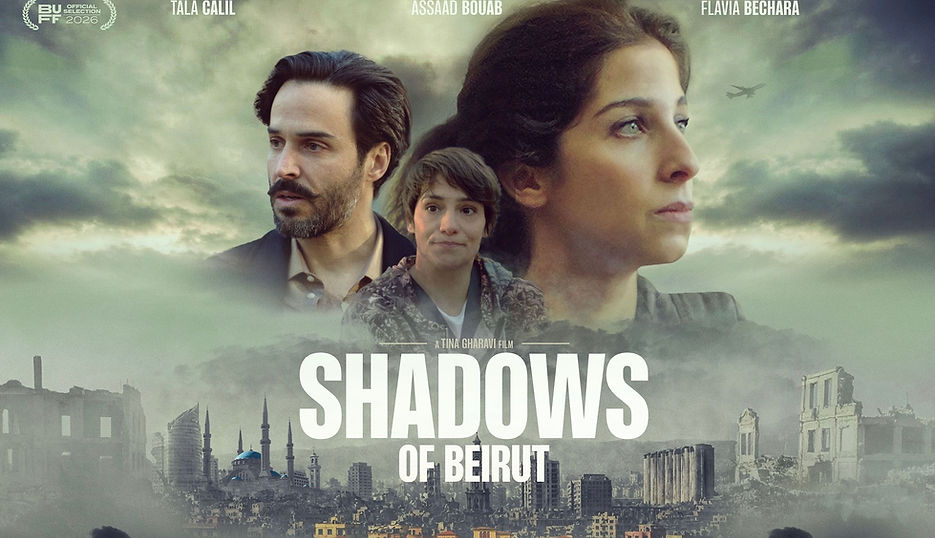
Shadows of Beirut is a feature-length film directed by up-and-coming filmmaker Tina Gharavi. The story follows a young woman named Lana, played by Tala Calil, working in London, who has been informed that her estranged father is gravely unwell and, in his near-death state, desires to see her.
Lena also suffers from severe OCD, which affects her daily life, as she is panicked by even the slightest possibility of germ transfer. As a result, in the first act of the film, she wears a mask in most scenes and appears explicitly uncomfortable in those where she is without one, and being close to others often triggers panic attacks for her.
The film takes place largely in Beirut, the capital of Lebanon. The film is shot well, emphasising the yellow, Arabian misty aesthetic the country is characterised by, while also focusing on the city’s industrial, often run-down, grey and beige architecture.
Early on in the film, Lana meets a significant friend named Sirine, played by Flavia Bechara, a friendly paramedic who helps her when in need. Their friendship, along with Lana’s own journey through the city, includes many intriguing scenes within the city of Beirut, particularly the outskirts, where viewers are guided around the streets, gaining an insider's perspective on the look of the city.
The camera ponders the more unsavoury aspects of the city, such as precariously standing tower blocks and eyesores of building works, providing sharp commentary on the economic divides within the country, and indeed the world, as Lana’s life in London is a very different-looking one to that of her adventures in Beirut.
Shadows of Beirut plays the clever balance of maintaining its storyline of Lana’s conflicting visit to her father, whilst truly, and most touchingly, being a film about unexpected connection. Lana and Sirine’s friendship is beautifully played out, Gharav and Bechara have extraordinary chemistry, and viewers, particularly women, can quickly grasp the way that they can become comfortable with one another as they discover they relate in more and more ways.
The way the characters interact continuously feels naturalistic, and we sense the way that Sirine becomes a beacon of hope for Lana as she struggles her way through an unfamiliar space and a difficult gaze into her family history.
The film heavily relies on performance, particularly facial expression, as Lana’s trepidation and anxiety tone the key moments of the film. This is cleverly contrasted with Lana’s times of ease, such as the time she spends connecting with Sirine. In addition, the film has a unique and powerful use of sound. Music is used sparingly and artfully, as viewers are encouraged for the majority of scenes to take in the soundscape of the city, paired with the vast cinematography of the urban space.
There are carefully crafted incorporations of colour contrast here, particularly when highlighting tonal shifts and emotional divides. Washed-out colours are used for moments of uncertainty and discomfort, whilst parts of the film which are more tender, characterised by connection, are painted through warmer yellow tones. In scenes where both feelings of difficulty and ease cross over, the cinematography marvellously creates a dichotomous colour scheme to highlight the nuance at play, letting viewers into Lana’s inner conflicts.
Overall, Shadows of Beirut is certainly an intriguing achievement in filmmaking. Whilst being a well-rounded family drama, with strong emotional shifts between love, connection, and anxiety, it is also a brilliant in-depth portrayal of mental illness, and a beautiful tale of friendship.
Shadows of Beirut in UK & Irish cinemas 25th September 2026.


About the Film Critic
