.png)
Once Upon a Time in the Apocalypse
Critic:
Lewis Mcleod
|
Posted on:
Oct 11, 2026

Directed by:
Tiago Pimentel
Written by:
Tiago Pimentel, António Miguel Pereira
Starring:
Sérgio Godinho, Mariana Pacheco, Paulo Calatré
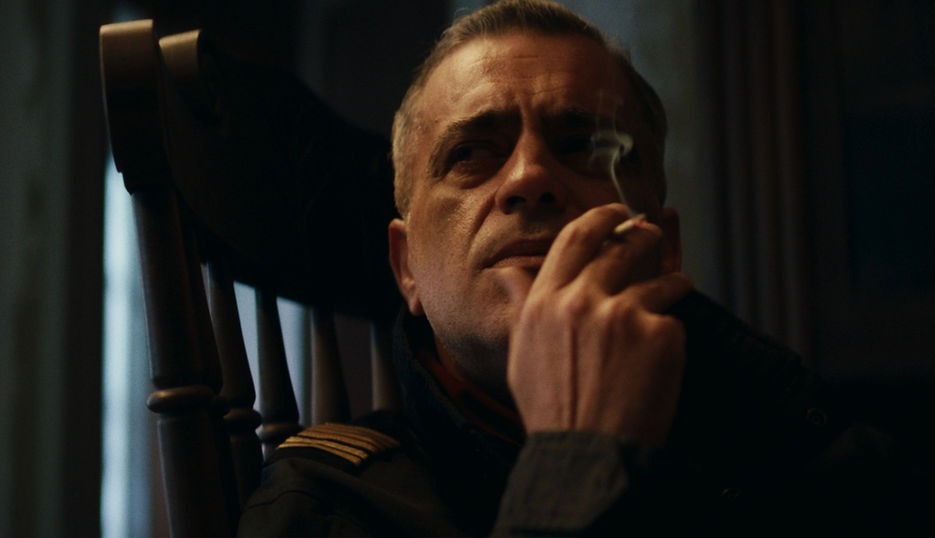
“Once Upon a Time in the Apocalypse” (“Era Uma Vez no Apocalipse”), a Portuguese short film released in July 2024, follows Ernesto (Sérgio Godinho), a rebel against the totalitarian regime present in the nuclear winter set in the seemingly not-so-distant future following an imagined version of World War Three. We, the audience, observe as Ernesto attempts to retain peace and safely hide his daughter, Helena (Marian Pacheco), alongside a rescued infant, when a strict colonel (Paulo Calatré) breaches their solitary cabin. Tension rises as the colonel establishes dominance over the course of the interrogation, allowing for a gripping altercation to occur in such a short amount of time and in one single setting.
The short instantly rings similar to media depicting Cold War confrontation: the air of recovery from a recently concluded war, authoritarian oppression, and those who are psychologically breaking underneath the weight of survival; this is immediately addressed in universe with a spoken comparison. In a scary fact, the aftermath of nuclear inclusion creating this winter-adjacent atmosphere is about the only thing to differentiate what we see here to what we have been exposed to hundreds of times before (e.g. George Orwell's Nineteen Eighty-Four).
Upon the colonel’s arrival, it is evident that Ernesto prioritizes the wellbeing of his family over that of the State. This is reinforced by his later revelation as a rebel on the run who operated during the war, fighting for freedom. Helena, now hiding in the house, is being hunted for stealing food from government warehouses; this allows for the involvement of deceptive tactics utilised by the colonel as he asks Ernesto if he may offer any confectionery (likely stolen). An unexpected Pinocchio book becomes the crux of the interrogation, a genius tool to explore the roles of our rebel and fascist ideologies. Ernesto, our “Pinocchio”, lies under positive intentions in an aim to do ultimate good, whilst the colonel (almost laughably) draws similarities between himself and Jiminy Cricket (this well-meaning cricket often serves as a conscience and moral compass for the titular character). A fascist state, whilst definitely eliminating lapses in judgement, would never hesitate in the killing of such troublemakers. “This is a strange new world,” the colonel claims, whilst only threatening the same punishment committed globally (and daily) preceding the fictional war. This irony is not hard to detect when scratching the surface of any autocratic power. The ultimate conclusion is shocking, yet telling of the cycles of war - violence will continue to fester amongst our species, even following nuclear action. I could also tell the interpretations of the surprise final twist, but a full viewing experience is definitely worth the jaw-dropping disclosure.
Operating under an approximate €6,000 budget, director Tiago Pimentel was able to generate almost a feature-length feel to this 21-minute runtime, almost as if this scene is a gateway into a much larger narrative; perhaps revenue generated may be channelled into future projects to explore this impending new world. This high level of professionalism can be attributed to cinematographer Tomas Brice, using an Arri Alexa camera equipped with Arri Aster Anamorphic Lenses to allow for a wide, cinematic scope. The hiring of Sérgio Godinho, one of the most influential and versatile forces in Portuguese pop music, and production designer Luis Sequeira, a two-time Oscar nominee for his work on The Shape of Water (2017) and Nightmare Alley (2021), certainly cements the influential nature of this production (carried out by Jângal Studios). Every detail is nailed to a T, whether the muted tones to immerse the viewer into this post-apocalyptic milieu, the straight-edged versus bending designs of the colonels and Ernesto’s brandy glasses, or the expertly crafted dialogue of the interrogation.
The film amassed a successful, multi-year festival run, winning several awards such as “Best Short Film” at Gen-Con Film Festival and undergoing screenings at San Diego and New York Comic Con. It also took advantage of the San Francisco Roxie Theatre’s First Looks Program in an effort to achieve Academy Award eligibility requirements.
It may be safe to say that this fictional conjecture does not solely exist on the basis of creating entertaining drama - it is a sharp warning of the establishments that the harsh nuclear winters could bring following a World War Three scale catastrophe. This intriguing approach takes a bottom-up view from the perspective of these secluded fugitives, rather than an overview of the entire world state throughout this aftermath, allowing for a more personalised and relatable feel. I would easily recommend “Once Upon a Time in The Apocalypse” purely on account of latter half absurdity; however, I would implore that the overarching message is taken at face value: fascist regimes are not just a thing of the past, and the end of the world may not be enough to stop them.


About the Film Critic
